
LoanStreet Monthly Newsletter — July 8, 2026
In this month’s edition of The LoanStreet Beat, we take a closer look at one of today’s most in-demand asset classes: Home Equity Lines of Credit (HELOCs). We’ll walk through the operational considerations, pricing methodology, and transaction structures that buyers and sellers should understand when evaluating a HELOC pool.
Below, we will start with a recap of an active economic news cycle and share our observations on loan trading.
Enjoy, share and please comment below!
LoanStreet Market Commentary
Kevin Warsh led his first Fed meeting in June as the Fed chair and signaled commitment to bringing down inflation to 2%. His tone was generally considered hawkish and resulted in short-term rates jumping over 16 bps. The key takeaway was his reiteration that the inflation target remains 2%, not 2-point-something. Traders are now fully pricing in a rate hike by the end of 2026.
As it stands, we are far from that 2% target and heading in the wrong direction. The personal consumption expenditures (PCE) price index, the preferred measure of inflation used by the Fed, rose 4.1% YoY. Even after stripping out food and energy, which have been particularly volatile due to overseas conflicts, core PCE increased 3.4% year over year.
Despite the increase in inflation, the consumer keeps spending. The latest report showing an 0.7% increase, above estimates. This is partially fueled by rising incomes, Real disposable income increased 0.3%, indicating household purchasing power continued to improve. Further fueling spending is the wealth effect caused by a stock market that has rebounded from March lows. This comes at the expense of the savings rate, which, at 3%, is the lowest since 2022.
On the employment side of the equation, the latest reading shows a slowdown in new job creation with 57k new jobs created as compared to the expectation of 113k. Despite the lower than expected job creation, the unemployment rate dropped to 4.2%, due to lower labor force participation. The unemployment rate only includes individuals actively looking for work. As labor force participation declines, fewer people are counted as unemployed, which can lower the unemployment rate even when job creation slows.
Loan Trading Trends and Implications
The first half of 2026 was the strongest start to a year we have seen in recent memory. Despite benchmark yields that drifted upwards from the start of the year, sellers were able to capitalize on strong buy-side demand and generate profit on their sales.
On the buy-side, competition for auto loans compresses spreads to levels we have not seen since 2021-2022. Direct auto pools traded at loss-adjusted spreads over Treasury of 60-80bps while indirect was as low as 100. Spreads have widened modestly from those lows but still trade at historically tight levels.
By comparison, first lien residential pools continue to offer attractive relative value. Second liens on the other hand, particularly HELOCs, have been in high demand driving prices up and yields down.
Outside of first lien residential, commercial real estate continues to provide attractive returns for buyers. Most sellers are not focused on profits when selling CRE and instead are more concerned with internal concentration limits. Which in turn means loans are sold at attractive levels relative to much of consumer loans.
Additionally, offerings in more unique asset classes such as land loans or equipment financing offer outsized returns based on buyer avoidance of new types of asset classes.
Deep Dive: The Science (and Art) of Selling HELOC Pools
As interest rate volatility remains elevated, demand for floating-rate assets has continued to grow. One of the primary beneficiaries has been Home Equity Lines of Credit (HELOCs), which have become increasingly attractive to participants seeking protection against future rate movements.
Despite strong buyer demand, many financial institutions remain hesitant to sell HELOC pools. Questions around pricing, ongoing servicing responsibilities, and the operational complexities of managing future draws often create uncertainty that prevents sellers from entering the market.
In this month’s LoanStreet Beat, we’ll explore both sides of the transaction. We’ll discuss the key factors that drive HELOC pricing, along with the operational considerations sellers should understand before bringing a pool to market.
Operational Considerations
Let’s start with a discussion of HELOC draws and how they are handled. Draws are often what keep sellers from entering the market in the first place because of uncertainty around how they are treated. Typically, draws are funded by the seller and are reimbursed at month-end through the monthly remittance process. If the monthly payments exceed the draws, the remittance to the seller is simply reduced by the amount of the draws. If the draws exceed the payments, the buyer reimburses the seller for the difference at month-end.
Be sure to track and maintain reports that separately identify payments and draws for each loan. A report that only shows the net amount is not sufficient. For example, if a loan has a $25,000 draw and a $1,000 payment, both transactions should be shown on the monthly report rather than reporting only the net amount of $24,000.
Modeling Cash Flows
Once the operational framework is understood, the next question becomes valuation. At its core, valuing a HELOC pool involves forecasting future cash flows and discounting those cash flows at a market yield. Unlike closed-end loans, HELOC pricing depends not only on the current balance but also on expectations for future draws, prepayments, utilization rates, and the path of short-term interest rates.
The first step is evaluating the future path of interest rates. This can be done using Bloomberg or the CME FedWatch Tool. As of June 30, 2026, the Prime Rate is 6.75%. Based on the Bloomberg projections shown below, the next Fed move is a 25-basis-point rate hike in September. Bloomberg’s implied move is 19.8 basis points because there is still a probability that the Fed leaves rates unchanged.
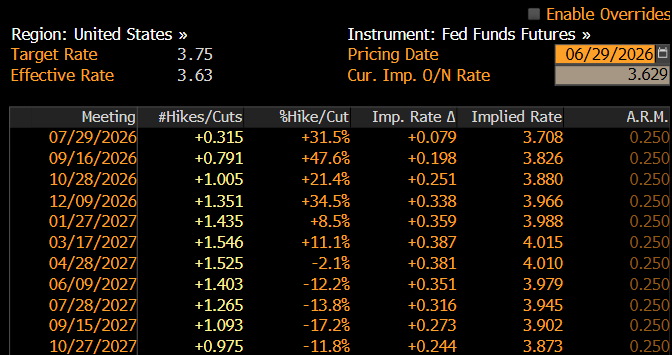
Using these projections, we model the cash flows by adjusting the HELOC coupon based on the implied Prime Rate plus the contractual margin. For example, a HELOC with a 50-basis-point margin would have a current rate of 7.25% (6.75% + 0.50%). Assuming the September rate hike occurs, the coupon would increase to 7.50% beginning in October.
Beyond interest rates, understanding the structure of each HELOC is equally important. Is there an interest-only period? How long is the draw term? These characteristics determine the expected cash flows and are incorporated into the model along with a prepayment assumption.
Estimating Prepayments
The prepayment speed is another key input when determining the value of a HELOC pool, particularly for pools trading at a premium. Several factors influence expected prepayment speeds.
First, it is helpful to know the interest rate on the first lien mortgage. A low first mortgage rate reduces the likelihood that a borrower will refinance both the first mortgage and the HELOC, resulting in slower prepayments.
Second, evaluate the margins offered on the HELOCs within the pool. If the margin is relatively high compared to current market offerings, borrowers may be able to refinance into a lower-rate HELOC with another lender, increasing prepayment speeds.
Lastly, the combined loan-to-value (CLTV) ratio is another important consideration. A higher CLTV generally means the borrower has less available equity, making it more difficult to refinance than a borrower with a lower CLTV.
Together, these factors help estimate how long the loans are projected to remain outstanding, which has a meaningful impact on the value of a HELOC pool.
Determining Market Value
Once you understand the structure of the HELOC, the path of Fed funds rates, and have a reasonable prepayment assumption, the next step is determining the appropriate yield and pricing for the pool.
The path of interest rates helps determine the market yield required by investors. For example, if rates are expected to increase by 50 basis points over the next six months, the current yield on the pool should reflect that expectation, as the coupon will increase along with Prime. As a result, a HELOC pool may trade at a modestly lower current yield than a comparable fixed-rate second lien product because investors expect the coupon to reset higher over time.
After the target yield is established, the next step is translating that yield into a price and servicing structure. Both are driven by the margin on the HELOCs, as well as the prepayment risk. All else equal, higher-margin HELOCs command higher prices because investors expect to receive larger coupon payments over the life of the loan.
However, maximizing the upfront premium is not always the best way to maximize the seller’s economics. Higher-margin HELOCs can also create a greater incentive for borrowers to refinance, increasing prepayment risk. If that risk is not appropriately reflected in the valuation, the buyer’s realized return can be significantly lower than originally modeled.
Instead, buyers may be willing to accept a lower required yield if the seller shares in the prepayment risk by accepting a lower upfront premium in exchange for higher ongoing servicing. Depending on actual prepayment speeds, this structure can ultimately produce greater total proceeds for the seller than simply negotiating the highest possible premium.
Putting it all together
Once the premium is established, the next question becomes: what balance should the premium be applied to? Should it be based on the credit limit, the current outstanding balance, or future draws? There is no industry standard.
In our view, the best approach is to apply the premium to future draws as they occur (for time-limited period, e.g., one-year post purchase). As each draw is funded by the seller, the buyer reimburses the seller for both the draw amount and the associated premium through the monthly remittance process. This allows the premium to be paid only on balances that are actually funded, rather than on unused credit availability.
At LoanStreet, this is automatically handled through our monthly remittance process and reports, which includes all of the payment and funding activities, including premiums to be paid.
In this article we focused on the operational and valuation aspects of pricing out HELOCs, without a deep discussion regarding credit risk. The ultimate yield target, and therefore price, will also be driven by the risk of the HELOC pools. Some areas to evaluate would be credit scores, CLTVs, DTIs, geography, lien position and vintage.
As demand for HELOCs continues to grow, more clients have sought guidance on both pricing and the operational aspects of HELOC transactions. Our marketplace regularly facilitates HELOC trades, giving us valuable insight into current pricing, market demand, and prepayment behavior. As with most loan participations, determining the right execution is part science and part art. Having the right assumptions, a thorough understanding of the operational mechanics, and the right technology to automate those operational complexities, can make a meaningful difference in the outcome for both buyers and sellers.
Monthly Economic Data Summary
- Based on the 6/25/2026 report, which reported May data, the PCE gauge of inflation was up 0.4% MOM, 0.1% below estimate and 4.1% YOY, in line with estimates.
- From the same report, core PCE, which excludes food and energy, was up 0.3% MOM and 3.4% YOY. Both inline with estimates.
- On 6/10/2026 we received the latest CPI gauge of inflation, the core number was 2.9%, matching estimates, while the non-Core was up 4.2%, also matching estimates.
- The latest job report for June showed a 57k increase in nonfarm payrolls, below the 113k which was estimated.
- The latest used-vehicle Manheim Market Report for mid-June showed a rise of 2.6% from a year ago.
- The Case-Shiller home price index showed national home prices appreciated MOM and YOY by 0.8%. These are lagging data and reflect the CS indices for 04/25.
- Based on the CME market watch tool, the expectation is for the Fed to start hiking rates during the October meeting.