
LoanStreet Monthly Newsletter — September 18, 2025
In this month’s edition of The LoanStreet Beat, we dive into how market participants can better manage their participation activity when rates remain volatile. We will cover trading from both the buyer’s and seller’s perspective and how both can succeed without trying to time the market.
Below, we will start with a recap of an active economic news cycle and share our observations on loan trading.
Enjoy, share and please comment below!
LoanStreet Market Commentary
Concerns over the labor market have pushed the Fed toward a rate cut, with markets now pricing in three reductions by year-end. Some economists caution, however, that easing policy while inflation remains above target could prove premature.
The August jobs report underscored the slowdown: nonfarm payrolls rose just 22,000, well below the 77,000 consensus estimate, while the unemployment rate edged up from 4.2% to 4.3%. Revisions also cast doubt on the strength of hiring over the past year, with payroll figures from March 2024 to March 2025 revised down by 911,000—effectively cutting in half the originally reported gains.
Inflation remains sticky but relatively stable. Headline CPI rose 2.9% year-over-year, matching expectations but up from 2.7% in the prior month. In contrast, producer prices offered a more encouraging signal: the PPI fell 0.1% month-over-month versus a forecasted 0.3% increase. Because PPI reflects the prices businesses pay for raw inputs, a decline suggests less cost pressure that could eventually flow through to consumers.
Looking ahead, the key uncertainties for the Fed and markets revolve around tariffs and their potential to reignite inflation. Meanwhile, despite labor market revisions, consumer activity remains solid—August retail sales rose 0.6% month-over-month, triple the 0.2% gain expected. Still, the strength is not evenly distributed. Moody’s data shows that the top 10% of earners account for roughly half of all consumer spending, highlighting the uneven foundation of growth.
Loan Trading Trends and Implications
Volatility in the interest rate market has led many buyers to pause, waiting for more clarity on the path of rates. After stronger-than-expected volumes in the typically slow months of July and August, September has opened at a slower pace—even though the recent decline in benchmark yields has widened spreads by 20–30 basis points compared with a month ago.
For opportunistic buyers, this environment offers a chance to capture additional spread while others remain sidelined. Historically, buy-side activity accelerates in November and December as institutions measure origination volumes against plan and turn to participations to meet growth goals. If this pattern repeats, spreads are likely to tighten again heading into year-end.
This dynamic is especially evident in residential loan pools, where yields have held steady despite benchmark rates falling 20–30 basis points. While credit concerns warrant attention—particularly if labor market concerns intensify—most pools continue to be concentrated in super-prime borrowers, who are expected to remain resilient even in a softer economy. Further, as home prices continue to appreciate, equity values underpinning the real estate provide a cushion against losses.
Deep Dive: Loan Trading Strategies When Rates Won’t Sit Still
When evaluating the yield on a loan participation, the typical approach is to compare it against a benchmark—most often the 2-year Treasury yield. This benchmark serves as a reference point for determining whether the yield being offered on a loan pool is appropriate.
The challenge, however, is that loan pool pricing is generally fixed, while benchmark yields are constantly moving—and sometimes moving sharply. To read about potential alternatives to the fixed price model, read our previous LoanStreet Beat article.
The chart below shows the 2-year Treasury yield over the past year. Note that today’s level is nearly the same as it was last September. Yet, in between, yields experienced significant ups and downs. As a result, the relative attractiveness of a loan pool depends heavily on when it was priced. In some cases, the yield on the pool may now look cheap compared with the benchmark; in others, it may look expensive.
Because it typically takes two to four weeks to close a loan pool transaction, some movement in benchmark yields is inevitable. This is especially true during periods of heightened rate volatility, as we’ve seen over the past few years.
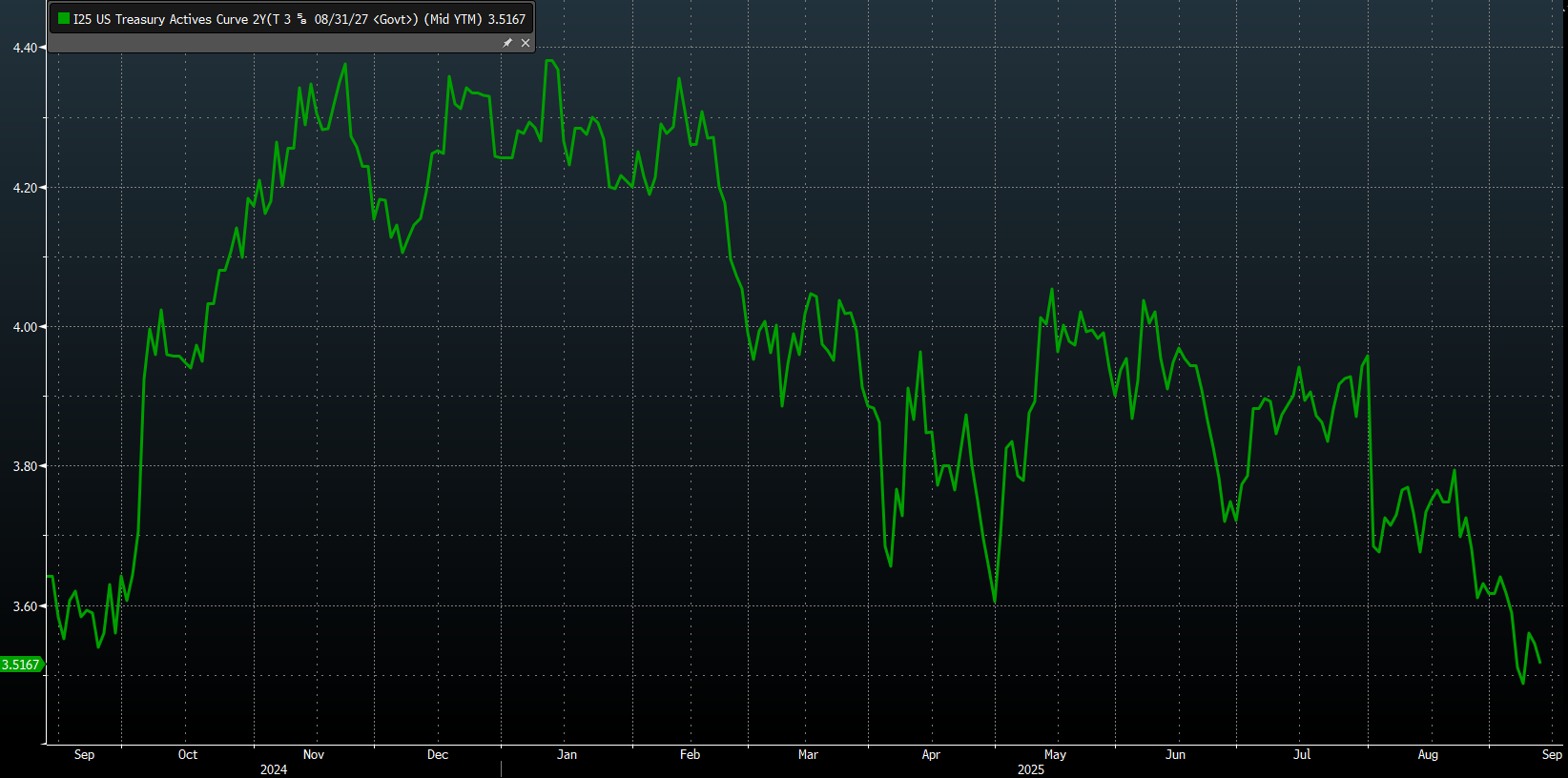
When rates are falling, as they have over the past few months, loan pool yields often adjust more slowly because buyer yield expectations tend to be sticky. This creates opportunities for buyers to capture extra spread until the market realigns.
The effect is especially pronounced for deals that were priced before a significant move in the Treasury market, since sellers are unlikely to reprice a pool once it has already been brought to market.
Dollar-Cost Averaging
For buyers hesitant to enter the market due to volatility, one of the most effective strategies is the same principle often recommended in investing: dollar-cost averaging. The LoanStreet marketplace makes this easier by allowing purchases of smaller pool pieces than would typically be required. By setting a regular buying schedule, you remove the pressure of trying to predict where rates will go; you simply purchase according to plan. And when pool yields lag behind downward moves in benchmark yields, you have the opportunity to buy more at attractive levels.
A similar approach applies on the sell side. Rather than bringing large pools to market all at once, consider selling at regular intervals. This reduces the need to worry about daily Treasury market fluctuations and helps build consistency. An added benefit is the development of repeat buyer relationships—investors who become familiar with your product and institution through prior transactions are more likely to return for future deals.
Expeditious Transactions
To minimize interest rate risk during the due diligence period, both buyers and sellers benefit from closing a pool as quickly as possible. The seller can accelerate this process by providing a thorough due diligence package upfront. This should include institutional-level documentation, loan performance data, and sample loan files. Just as important, the seller should be transparent about any potential issues—such as missing documentation, spikes in charge-offs, or policy changes—so buyers aren’t surprised later.
From the buyer’s perspective, it’s essential to flag any issues uncovered during due diligence as early as possible. Often, missing documents are simply the result of an oversight rather than intentional omission, and sellers may not realize that a particular item is important to you if other buyers have never requested it. Clear, early communication helps ensure the process moves forward efficiently.
Yields are Forward-Looking
Finally, when it comes to future moves in Treasury yields, many clients tell us they hold off on trading until after the Fed’s next meeting—expecting that a rate cut or hike will directly move the market. But it’s important to remember that the Treasury market is forward-looking. It anticipates both future economic data and potential Fed actions.
For example, if the entire market already expects the Fed to cut rates by 25 bps, that expectation is typically priced in well before the announcement. As a result, those waiting for yields to drop after the meeting may end up disappointed.
That doesn’t mean the Fed can’t surprise the market. A more dovish or hawkish tone than expected can still push yields one way or the other. But relying on a specific market reaction to a Fed meeting has historically been a difficult—and often frustrating—strategy.
Just as in other investments, timing the market can prove to be challenging. Buyers and sellers are better served participating in the markets on a regular basis which helps reduce the impact of market volatility.
Monthly Economic Data Summary
- Based on the 7/31/2025 report, the PCE gauge of inflation was 0.3% MOM, in line with estimates, and up 2.6% YOY, above the 2.5% estimate.
- From the same report, core PCE, which excludes food and energy, was up 0.3% MOM, as expected, and 2.8% YOY, above the 2.7% estimate.
- On 8/12/2025 we received the latest CPI gauge of inflation, the headline was an increase of 0.2% MOM, matching estimates, while the YOY was up 2.7%, below the 2.8% estimate.
- The latest job report for July showed a 73k increase in nonfarm payrolls, below the 105k which was estimated.
- The latest used-vehicle Manheim Market Report for July showed a rise of 2.9% from a year ago.
- The Case-Shiller home price index showed national home prices increasing MOM by 0.4% while increasing YOY by 2.3%. These are lagging data and reflect the CS indices for 05/25.
- Based on the CME market watch tool, the expectation is for the first rate cut of 2025 to happen in September.
This article was authored by Matt Rudzinski, VP of Capital Markets
For more market commentary and to learn more about LoanStreet’s solutions, visit www.loan-street.com
Disclaimer
LoanStreet is not a Registered Exchange, Financial Planner, Investment Adviser, or Tax Adviser. The information provided herein is for general informational purposes only, and does not, and is not intended to, constitute legal, financial, investment, or tax advice.